Stochastic Gravitational Wave Background Research
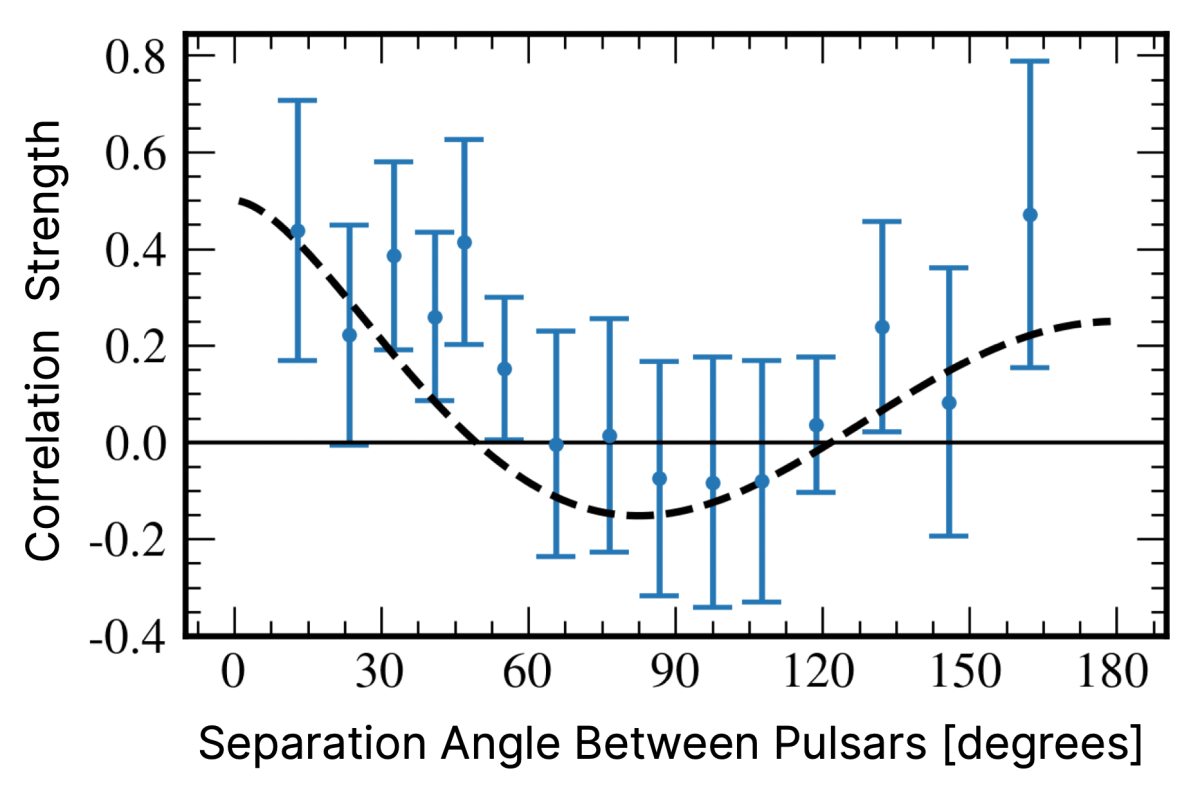
Probing early universe physics through pulsar timing arrays and gravitational wave astronomy (Plot Credit: NANOGrav)
Probing early universe physics through pulsar timing arrays and gravitational wave astronomy (Plot Credit: NANOGrav)
We analyzed the NANOGrav 15-year dataset to probe early universe physics, focusing on the effects of a nontrivial reheating phase after inflation. Using a power-law parameterization of the gravitational wave (GW) spectrum, we constrained the reheating equation of state and temperature, finding strong implications for the transition into the radiation-dominated era.
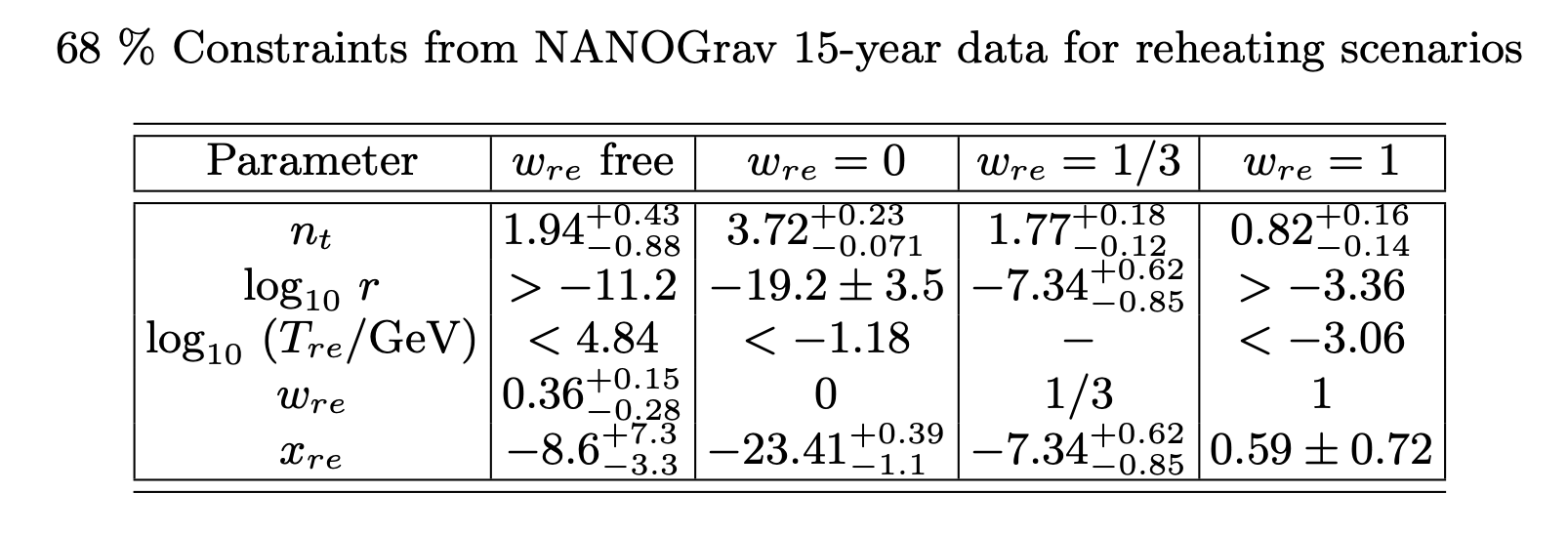
Figure: The mean $\pm 1 \sigma$ constraints on the primordial and reheating parameters inferred from the NANOGrav 15-yr data for different reheating models.
Our likelihood analysis of the NANOGrav 15-year data shows strong support for a primordial stochastic GW background with a blue-tilted spectrum, consistent with both canonical inflationary scenarios and exotic models like sourced bounce cosmologies. The best-fit value of the tensor spectral index is \( n_t \sim 2 \), and the inferred reheating parameters suggest a transition close to radiation domination. We propose scenarios involving a mixed GW background or running spectral index to resolve tensions with LIGO bounds. These findings open new avenues for probing reheating physics using GW data from PTAs.
We critically assessed the interpretation of the NANOGrav 15-year dataset as evidence for a primordial stochastic gravitational wave background (SGWB). Our analysis highlights that a simple power-law tensor spectrum is inconsistent with current LIGO bounds and must involve spectral breaks or running. Furthermore, any cosmological origin must also comply with CMB constraints, particularly limits on extra radiation energy density quantified via $\Delta N_{\rm eff}$.
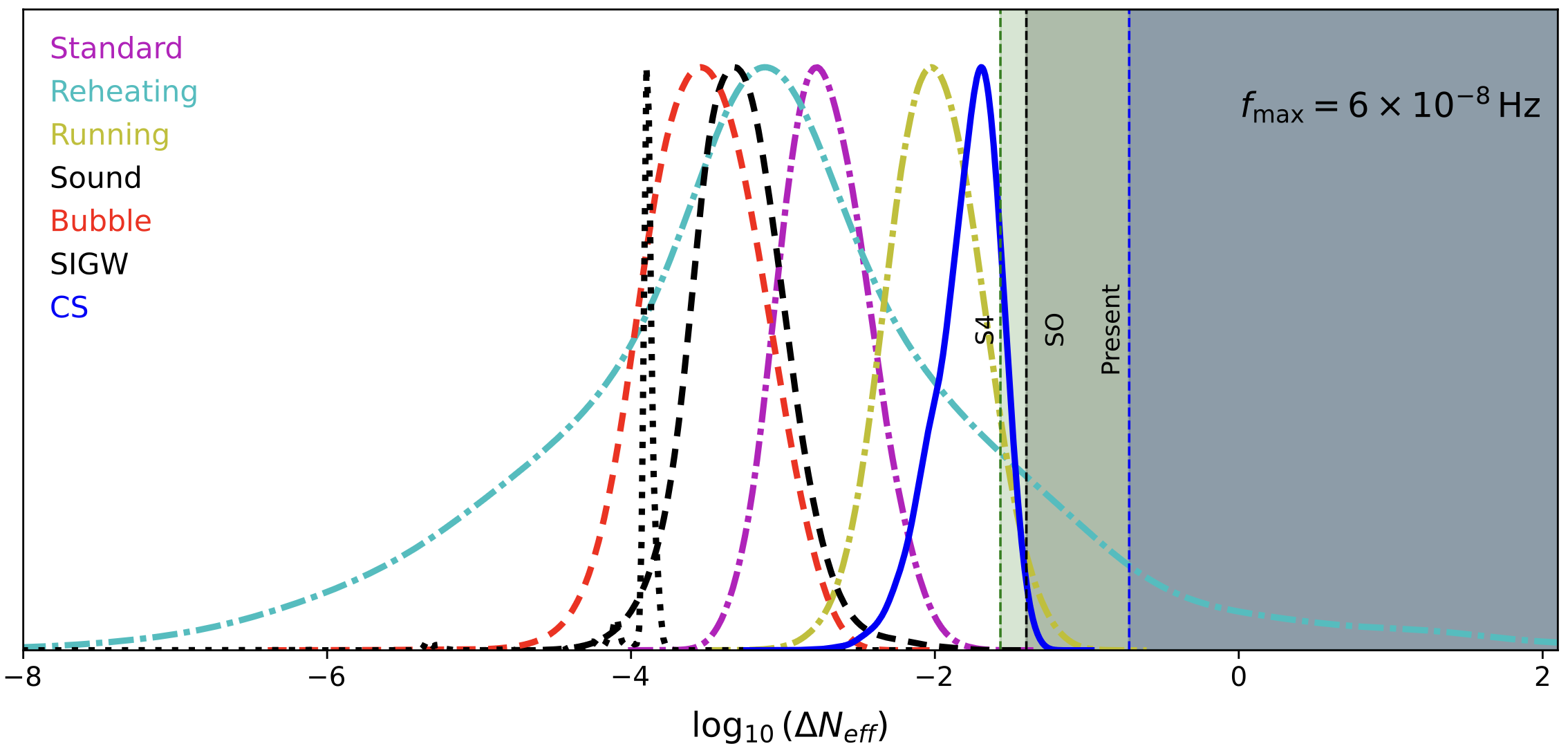
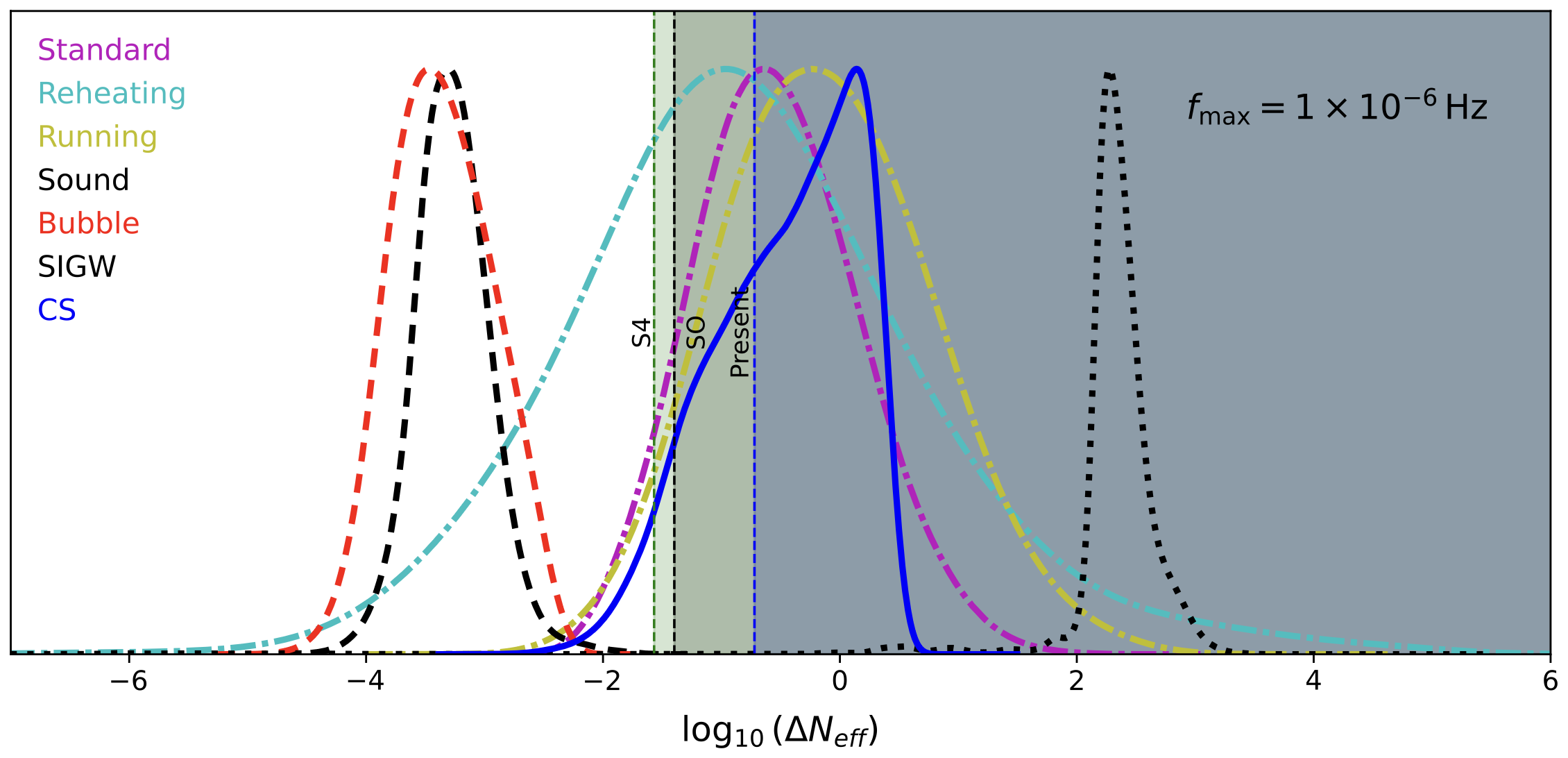
Figure: The marginalized 1D posteriors on $\log_{10} \Delta N_{eff}$ for all models first calculated only for NANOGrav probed frequency range (Top) and then extrapolated till $f_{max} = 1 \, \rm \mu Hz$ (Down). For reference, we also present the `detectability zone' from (present) Planck 2018, SO, and CMB-S4 experiments, corresponding to the dashed vertical lines at $\sigma_{P18}= 0.19$, $ \sigma_{SO}= 0.045$, and $ \sigma_{S4}= 0.027$ respectively.
Our Bayesian analysis of Early-Universe gravitational wave models, constrained by both NANOGrav and Planck data, shows that several cosmological scenarios—especially those predicting large $\Delta N_{\rm eff}$—are strongly disfavored. Scalar-induced GWs and inflationary models with strong spectral running exceed current radiation bounds and are excluded at high confidence. We emphasize the unique role of $\Delta N_{\rm eff}$ as an independent cosmological probe of primordial SGWB, with future CMB experiments (e.g., CMB-S4, Simons Observatory) expected to decisively test remaining viable models.