
CMB Lensing Anomaly & Non-Cold Dark Matter Constraints
Two conclusions: (1) scale dependence and Planck low-$\ell$ driving of the CMB lensing anomaly; (2) DESI evidence for a non-cold dark matter equation of state.
Two conclusions: (1) scale dependence and Planck low-$\ell$ driving of the CMB lensing anomaly; (2) DESI evidence for a non-cold dark matter equation of state.
We scrutinize the reported lensing anomaly of the CMB by considering several phenomenological modifications of the lensing consistency parameter, $A_{\rm L}$. Using Planck power spectra alone we find statistically significant evidence for a scale-dependent (``running'') lensing amplitude. Parametrizing the deviation as an expansion of the form $A_L(\ell)=A_{\rm L}+B_{\rm L}\log(\ell/\ell_0)$, CMB-only fits show preference for $B_{\rm L}\neq 0$.
Crucially, we demonstrate that the anomaly is entirely driven by Planck's lowest multipoles, $\ell \leq 30$. When these multipoles are excluded, a joint analysis including WMAP, ACT, SPT and low-redshift probes clearly favours $\Lambda$CDM over extended $\Lambda\text{CDM}+A_L(\ell)$ models. In that case the lensing anomaly and the low-$\ell$ anomaly both vanish, the $S_8$ tension is ameliorated, and the only remaining major discord is the Hubble tension.
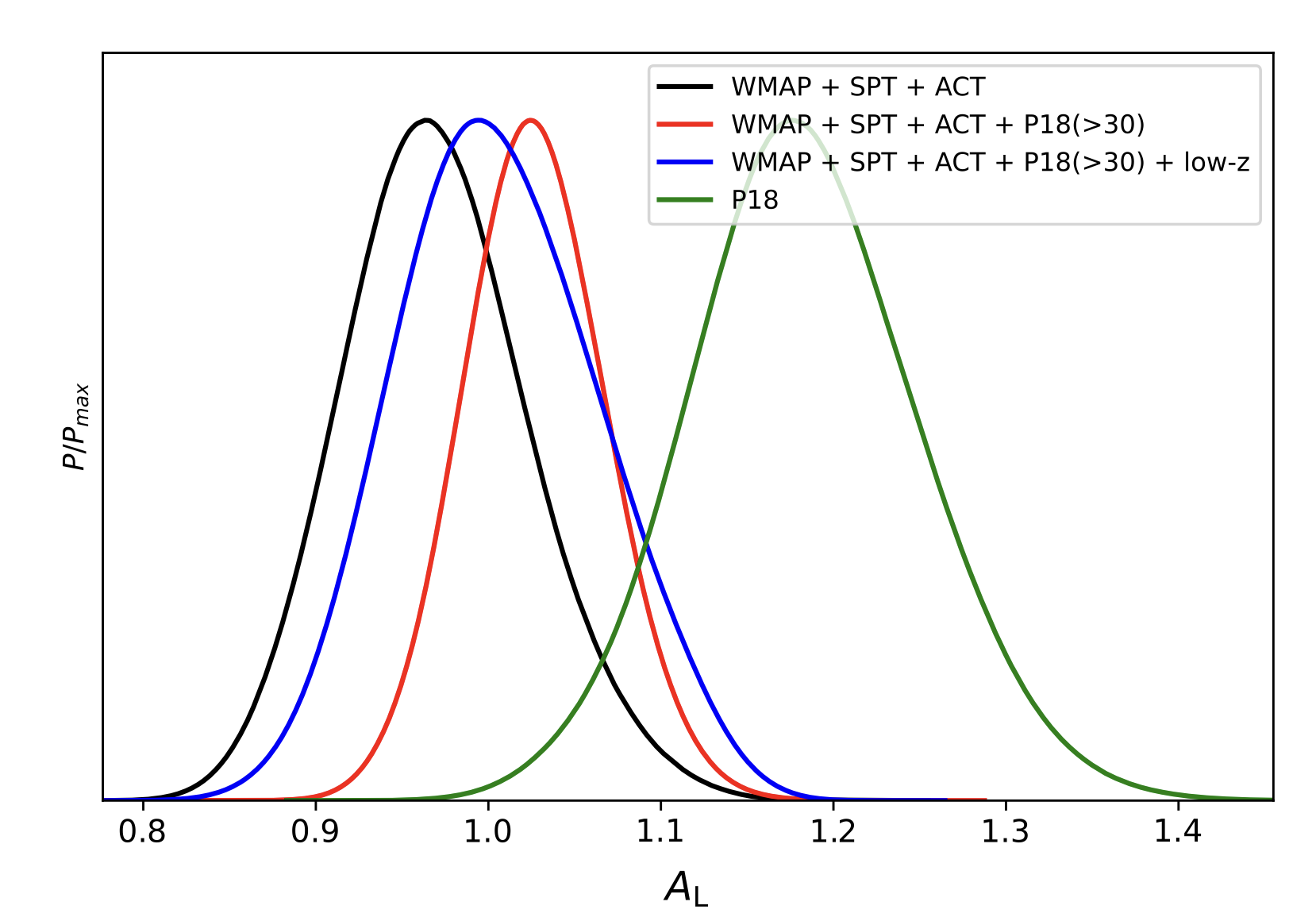
Figure: Evidence for scale dependence in $A_{\rm L}$ from Planck spectra. Removing $\ell\leq 30$ (right) restores consistency with $\Lambda$CDM and with complementary CMB probes.
The apparent CMB lensing anomaly is consistent with a scale-dependent lensing amplitude when using Planck spectra alone, but this signal is driven by the lowest multipoles ($\ell\leq30$). Excluding those multipoles brings Planck into agreement with other CMB experiments and low-redshift data, removing the lensing and low-$\ell$ anomalies and reducing the $S_8$ tension. The surviving Hubble tension suggests the cosmological concordance model remains broadly consistent, but care must be taken to treat Planck low-$\ell$ data and potential systematics when interpreting extended-model inferences.
We consider a dark matter component with energy density $\rho_{\rm dm}$ and equation-of-state parameter $w_{\rm dm}$. Using the latest Baryon Acoustic Oscillation (BAO) measurements from DESI we test for deviations from cold dark matter (CDM, $w_{\rm dm}=0$).
DESI data alone gives $w_{\mathrm{dm}} = -0.042^{+0.047}_{-0.024}$, showing a mild preference for non-cold dark matter. The preference strengthens when combining datasets, but different dataset combinations produce a striking tension in the inferred $w_{\rm dm}$ values: DESI+DESY5 yields $w_{\mathrm{dm}} = -0.084 \pm 0.035$ (excluding CDM at $2.4\sigma$), whereas Planck+DESI gives $w_{\mathrm{dm}} = 0.00077\pm0.00038$, consistent with CDM and differing from the DESI+DESY5 result at $\sim2\sigma$.
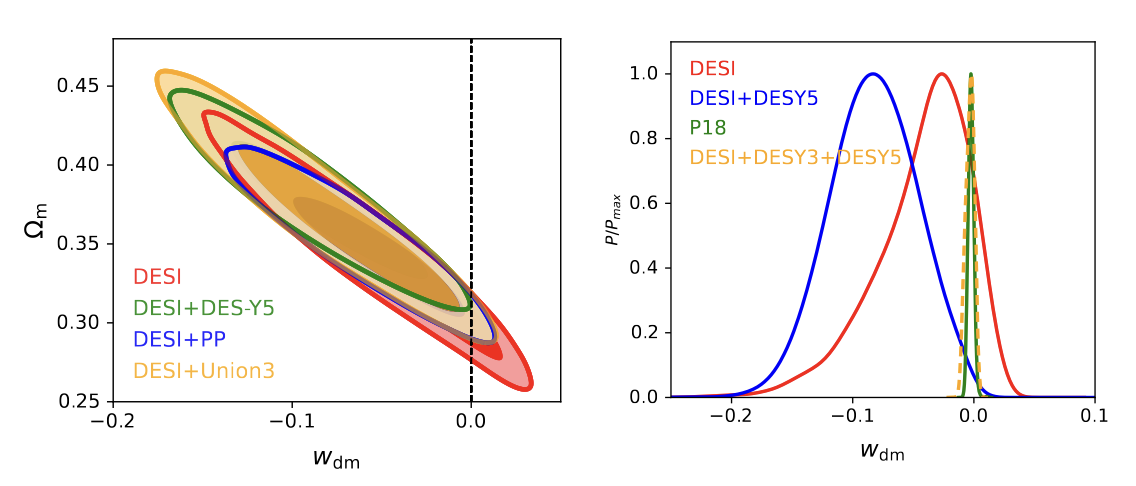
Figure: Two-dimensional confidence contours (68\% and 95\% CL) for the cosmological parameter pairs $\Omega_{\mathrm{m}}$--$w_{\mathrm{dm}}$, derived from \textsc{DESI} and supernovae (SN) datasets.
DESI BAO measurements provide intriguing evidence for non-cold dark matter when considered with certain low-redshift data combinations — a signal driven by $z<1.1$ observations. However, high-redshift constraints anchored by Planck prefer CDM, producing a notable tension between datasets. The improvement in fit over $\Lambda$CDM across combinations motivates further scrutiny: either we are seeing early hints of genuine non-CDM physics, or there remain dataset-dependent systematics to be resolved. Future cross-checks, expanded DESI analyses, and independent low-$z$ probes will be decisive.